Guillermo Remón is a historian with a master’s degree in International Relations. He has worked on social inclusion at international organizations, as well as in private consulting in the public sector. He is currently the project manager for the European ReDes_Ling project, of which MIRCo is a part.
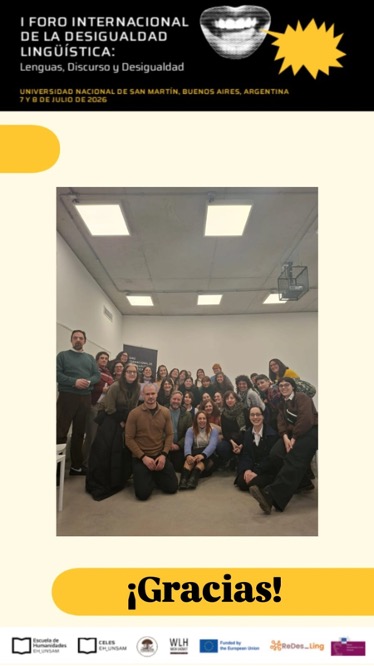
The Resistir la Desigualdad Lingüística (ReDes_Ling, Resisting Linguistic Inequality) project is an intercontinental network funded by the European Union. Its main purpose is to bring together universities and social organizations to combat discrimination based on language. As part of this initiative, the First International Forum on Linguistic Inequality was born with the goal of highlighting the project’s progress while fostering synergies within an ecosystem of dialogue. The first phase of the event took place at the National University of San Martín, a public institution located on the outskirts of Buenos Aires. A few days later, the gathering would move to the northern Chaco, an Argentine region marked by the historical vulnerability of its indigenous communities. However, this travel journal focuses exclusively on my days in the capital. The time in Buenos Aires marked my first genuine encounter with sociolinguistics, a subject that ceased to be a mere academic discipline and revealed itself to me as a vast space for debate.

Arriving in Buenos Aires to coordinate this First Forum on Linguistic Inequality has meant immersing myself in a new ecosystem that—given my undergraduate studies in History and my master’s degree in International Relations—felt somewhat foreign to me and that I had previously engaged with only in a utilitarian manner: language. Throughout my professional career, my work has focused on public policy design and the management of European projects. As a consultant in the public sector and an analyst of social protection strategies for the Organization of American States (OAS), I have spent years studying and addressing socioeconomic disparities and evaluating inclusion projects for vulnerable populations in Latin America and Spain. However, even without ever diving too deeply into its profound implications and structures, I have come to understand how sociolinguistics transcends formal political discourse and rhetoric to become a vital battleground. Attending every lecture meant discovering something new, not only on a theory level but also within myself. It was an awakening that, while familiar to me because of my social calling, also felt like a rite of passage.

This account is not a logistical assessment typical of my role as the consortium’s Project Manager; it is the observation of an outsider who has explored the intricacies of linguistic complexity.
My first conceptual encounter with what I would later learn in greater depth during the Forum began on the afternoon of Monday, July 6th, at the Instituto Lenguas Vivas, a higher education institution that—much like Buenos Aires’s architecture—exuded history, neoclassicism, and the city’s characteristic humidity.
In a small venue, watching the screening of the documentary “Más allá de la traducción” (“Beyond Translation”), I once again came face-to-face with the inequality to which I have devoted so much time in my professional career—this time in the linguistic sphere. Something as fundamental and taken for granted as communication hides—as in all socioeconomic spheres where inequality manifests itself—a structure that remains exclusionary, colonial, and, I would dare to say, cruel.
Hearing firsthand accounts from the Wichí and Qom indigenous communities from the Chaco, and understanding how linguistic violence spreads its tentacles—restricting basic universal human rights such as access to healthcare or justice—led me to a familiar place: outrage and a desire to dig deeper to try to understand why these dynamics of exclusion exist and how they can be mitigated.
For someone used to fighting inequality from the bureaucratic calm of an office—managing EU Next Generation funds or analyzing the Minimum Living Income—hearing the raw, unvarnished testimonies presented in the documentary was heart-breaking. It not only strengthened my commitment to the fight against inequality but also encouraged me to approach it from a new perspective. A new dimension of study, intimately intertwined with everything to which I have dedicated years of study and work. The old and the new.

The multilingual reality presented—and its correlation with discrimination—completely redefines the translator’s work. It becomes clear that the act of translating is, literally, a tool for survival. The voice must be redistributed.
On July 7th, the forum expanded to UNSAM’s Miguelete Campus, with classrooms operating at full capacity and voices coming from Uruguay, Chile, and many corners of Argentina. The panels on glottophobia (the rejection or discrimination against a person based on their way of speaking) caught my attention, removing—if I may use this simple analogy—the blindfold from eyes eager for the truth. Reflecting on how our own institutions and media erect invisible barriers that segregate speakers—and witnessing the interdisciplinary exchange of knowledge as we debated plain language in government, biases in artificial intelligence, and intercultural interpretation—showed me that the ideas generated here possess immediate transformative power.
As evening fell, during the assembly “La palabra como trinchera” (“The Word as a Trench”) and the presentations of the ReDes_Ling website and the book “Transmitir lenguas indígenas hoy” (“Transmitting Indigenous Languages Today”) I was certain that knowledge was not enclosed to an academic circuit; it was spreading organically throughout society, empowering its actors—among whom I felt I belonged.
Although I was unfamiliar with the tool, I found that we did, in fact, share the same convictions and goals. It was a truly stimulating experience.
That same intensity marked the closing day on Wednesday, the 8th. The debates on the global hegemony of English, the permeable boundaries of “Portuñol” (that fluid contact zone between Portuguese and Spanish), and epistemic violence in migratory flows directly challenged my background as an internationalist. Inequality also manifests itself in systematic silencing. However, in the face of this, I witnessed an enormous capacity for territorial and creative resistance, embodied, for example, in the publication of books by Editorial Meninas Cartoneras (an initiative that repurposes cardboard to create literature) and, more broadly, in the activism—as necessary as it is positive—of the communities and participants at the event.
The classrooms at UNSAM became a familiar place, a space where I had discovered something about the world, but also about myself—not merely by extension, but because of the deep conviction growing in me. Because of that seed of rebellion that each of the speakers had managed to plant within me during those days of bustling activity and ideals.
By observing the strong cohesion of this group over the past few days, I realize the true scope of our network within the ReDes_Ling project. Knowledge, stories, and tools of resistance have flowed horizontally among researchers, activists, and citizens. This forum has transformed me as an observer, showing me that the transatlantic bridge we maintain has a real impact, bringing knowledge, empathy, and visibility to the communities that need it most.