Juan, Santiago, and Magui are linguists from Argentina who work on the edge of research, intervention, and political-linguistic reflection. In 2020, they came together to create “Hablando Mal y Pronto”, a linguistics podcast that explores a variety of topics in the field of language studies with a relaxed and contemporary style.
“Let’s make a podcast.”
That was the idea. It was July or August 2020, right in the middle of the COVID-19 lockdown in Argentina, and we were discussing uninteresting topics on Twitter when someone threw out that phrase. Those of us with formal jobs and privileged economic and housing conditions were driven by a manic energy that pushed us to “get things done”: improving our virtual classrooms, participating in informational campaigns (and anti-fake news efforts), organizing international events and activities via videoconference, catching up on reading, and writing articles we’d been putting off. All of this amid sourdough baking, at-home workouts, applause for healthcare workers, and Zoom birthday parties.
Amid that tornado of domestic life, we decided it might be a good idea to start a podcast about linguistics. We wanted to share what we do with a wider audience than just our regular readers and listeners; there was a real appetite for science out there, and there was almost no popular science content on linguistics in Spanish. Plus, we figured we’d have a good time, learn things we didn’t know, and meet interesting people.
There were three of us: María López García, Santiago Kalinowski, and Juan E. Bonnin. The name, Hablando mal y pronto (HMP, for short), was suggested by Magui, who had been thinking about it for a while and gave it to this project. She also created the cover image: Scrabble tiles against a somewhat aquatic background. The first episode was released on October 27th, 2020.

We began with topics that interested us and that we thought might interest others: linguistic taboos, myths, and the norm. One of those early episodes was called “On Why Everyone Speaks Incorrectly (Except Us),” and it could very well have been the show’s second title.
Since we’d never recorded a podcast before—nor had we ever been through a pandemic—everything was new to us. At first, we’d record ourselves with our phones during a video conference and then merge the files into a single audio track. Later, we each got our own recorders, and the sound quality improved significantly, though it remained HMP’s technical weak point. When the pandemic situation changed, we started meeting in person to record and conduct interviews. It was a new phase for the podcast but, above all, a new phase of life after the pandemic: sitting down at the same table again.
HMP never had a mass audience. When we engage in outreach, we often say that we’re speaking to the “general public,” but we know that such an audience doesn’t exist. There’s also a somewhat narcissistic element to believing that thousands of strangers will want to know what we think about linguistic relativism or the ideological leanings of the entries in a 19th-century dictionary.
We had two specific audiences in mind. First and foremost, language teachers, especially those at the middle and high school levels. In our experience, this is a very inquisitive audience that is constantly seeking to stay up to date—not only for professional reasons but also out of a genuine interest in advances in the field of linguistics. Reaching out to teachers is an opportunity to reach their students and their families. Second, we’re addressing professionals in language-related fields, such as editing and proofreading, as well as our fellow linguists. In this case, we were interested in the diversity of specialization areas within the language sciences and the limits of our own knowledge. Although we started by discussing topics we knew very well, from the very beginning we wanted to avoid giving the podcast a didactic tone. We weren’t looking to explain, but rather to converse, discuss, and learn.
Over time, we began inviting colleagues who knew things we didn’t. Oscar Conde spoke to us about lunfardo, Rocío Martínez about Argentine Sign Language, Virginia Jaichenco about what happens in the brain when we speak, Valeria Abusamra about what happens in the brain when we read, Luis Fernando Lara about how a dictionary is made, Sara Pérez about hate speech, and Carina Meynet and Martín Tapia Kwiecien about etymology. We also hosted our own series: inclusive language, spelling, forms of address, and dubbing—to which we dedicated no fewer than five episodes (with Marcos Rohena-Madrazo and Carlos “Casper” Uncal)—as well as artificial intelligence, with Alejandra Litterio. Talking with specialists from other fields allowed us to become an audience for HMP as well.
Each episode took more work than what is thought: preparing the content, finding and coordinating guests, recording (the most fun part), and editing (the most tedious part). Since we had no experience, we produced the episodes with little planning. We never decided whether we were going to do seasons, and we didn’t even agree on how many episodes we’d done: according to Spotify, there are 43. The first ones lasted about forty minutes and covered the topic exhaustively (and probably wore out the audience, too). Then we moved on to episodes around fifteen minutes long, in which we explored one aspect that could be continued in the next episode.

The energy from the quarantine gradually faded as life returned to normal, with all its activities, and in 2023 the podcast lost its momentum. We stopped meeting because life got in the way and we no longer had time.
But it wasn’t completely over.
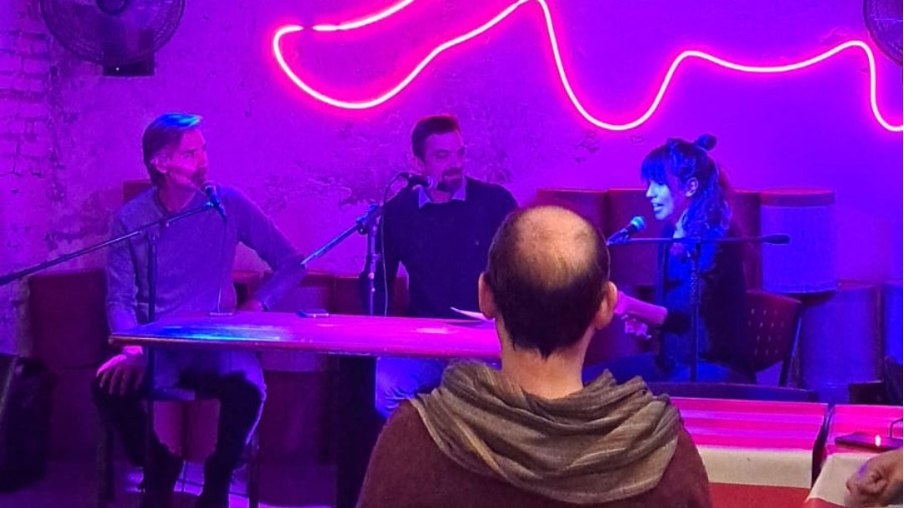
In October 2023, we held a gathering with listeners at La Casa del Árbol, a cultural center in Buenos Aires, and answered questions from the audience; it was released as a live episode.

This year, in July 2026, we were invited to the 7th Latin American Congress on Glotopolitics and recorded another episode—with Valeria Abusamra—on linguistic myths. Almost six years later, we returned to one of the topics we’d started with.
There are still people who listen to us and are interested in the podcast, and they ask us when the next episode will be. The upside of not having set a fixed schedule: the next one will be out whenever it’s ready.
In the meantime, the first 43 episodes are still available on Spotify for anyone who wants to listen to them.
Better late than never, of course.